Lily Alexander
Santa Fe New Mexican
August 14, 2026
Sergio Lugo held his first pottery show at age 7.
His first client was his father, who waited all day to buy his pieces — which, Lugo noted, “looked like a 7-year-old made them.”
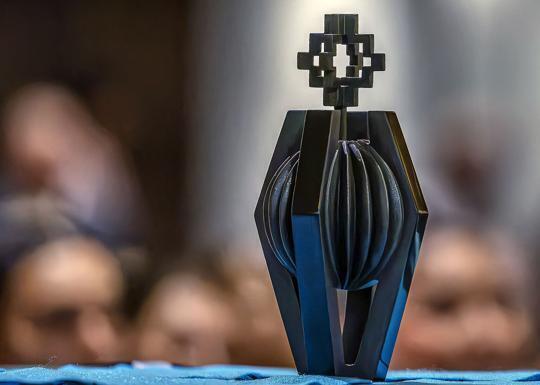
A Santa Clara Pueblo potter in a family of artists, Lugo became the latest in his lineage to win the Santa Fe Indian Market’s coveted Best of Show award Friday. The accolade was for his piece Floating Melon Bowl, a four-sided melon bowl made of hand-dug clay with a Kiva step lid.
“I still think you guys are playing with me,” Lugo joked in a speech. “But I’m going to play along, see what happens.”
The win was particularly special given the history of Floating Melon Bowl, which Lugo said he almost did not finish. The final version was the bowl’s fourth iteration.
Typically, when he makes pottery, Lugo begins the process and lets the piece tell him what it wants to be, he said in an interview. With Floating Melon Bowl, he knew what he wanted to make, but he “didn’t know how to do it.”
He started by creating a miniature version of the bowl. When he made the larger version, all the legs cracked as he was carving it.
Though he was tempted to give up, Lugo said, he pushed through and worked on the piece largely nonstop from midnight to noon, April through August. As the project neared completion, he had a dream the pot cracked — again — while he was firing it.
“I’m really happy that people saw how hard I worked on this, because I was going to give up and not do this piece,” he said. “And I’m just happy to represent my Pueblo and my ancestors.”
His mother, sister-in-law, and late great-grandmother have also taken home the Best of Show award in years past, Lugo said. His great-grandmother, Margaret Tafoya, is known as the matriarch of Santa Clara Pueblo potters.
Lugo credits his mother with helping to revitalize his art career in 2022 — six years after he decided he would quit pottery permanently. Every year following that declaration, she asked him to start creating again, offering to give him clay.
Eventually, he went home and got to work.
“I made 10 pieces,” Lugo recalled. “It was really, really hard, because I had to relearn everything that I was struggling with already, six years prior. I showed up to Indian Market with $500 in my pocket, 10 pots and no idea how to pay rent the next day. And people really liked my work.”
Lugo fought back tears as he walked to the stage Friday at the Santa Fe Community Convention Center when his name was called. The room lit up with applause.
“I’m just so grateful for everyone that has supported me,” he said. “I wouldn’t be here without all the people in my life. You can work as hard as you want, but you need a little help.”
Other winners
More than 150 judges and volunteers gathered Thursday to review and critique this year’s entries, according to a news release.
Lugo — who also won best of classification in pottery — was one of several artists from New Mexico tribes and pueblos who were honored at Friday’s ceremony, which kicked off Indian Market weekend. Beyond Best of Show, the Southwest Association for Indian Arts gives out 10 other awards across different classifications. Special awards, including the Institute of American Indian Arts Alumni Award, were also distributed.
Marla Allison (Laguna Pueblo) won the painting, drawing, graphics and photography classification for her painting titled Life, a self-portrait she said represents both her own resilience and the resilience of all people. Made with acrylic paint and gold and silver leaf, the large piece features eye-catching pops of bright red and splashes of a starry night sky.
“This piece was definitely all the highs and lows of life,” Allison said in an interview. “And to be able to be a painter while going through that is very difficult — to be able to refocus away from life and to pull into the creativity of what is truly needed as an artist, to make the time to dedicate to myself, but also to my art that is given from this higher power. And to focus all that together as on a canvas — just, it all came together.”
Both women depicted in the painting have visible wounds, but one of them dons a bow guard. It is one of several symbolic “Easter eggs,” as Allison called them, that harken back to her personal journey and what she hopes to embody.
“More so only men are allowed to wear that in my tradition,” she said of the bow guard. “But I thought I’ve earned it as somebody that will defend for everything with a bow and arrow.”
Allison said she feels lucky just to be considered part of the world’s largest Indian Market alongside her fellow artists.
“So to get an award is like, ‘Wow, cool,’ ” she said.
Navajo silversmith Tonya June Rafael, who is from Blackwater, a place near Gallup that is too small to be a town, and Santo Domingo Pueblo artist Jolene Bird were the only artists who won for a collaborative piece. The best friend duo won the diverse arts classification for their pair of dolls named Harry and Anabella, which represent an old Navajo couple.
The dolls are made of wood, Nevada turquoise, green serpentine, coral and silver. Rafael did the metalwork and Bird did the inlay work.
The pair first met at an art show in Indiana and began traveling together, they said during their speech. Harry and Anabella is the realized product of years of discussing a potential collaboration.
“I’m so happy,” Bird said. “This is a surprise for me, too.”